
Once upon a time there were two monks. One of them lived in the forest and was a being who could remain in meditation for days, motionless, immersed in ecstasy, deeply absorbed in his inner universe.
One day, a hungry tiger passing by saw this motionless monk in deep meditation as potential prey, approached, and ate him.
The other monk lived in the city and was a benevolent being, always ready to help, always available to welcome and comfort those who sought him. One day he was diagnosed with a serious internal illness and died weeks later.
These stories represent for me the paradigm of those who teach Chi Kung or find themselves on the therapeutical realm.
The need to nourish ourselves, to have a regular practice, to regenerate ourselves, to maintain a balanced diet, to study, to sleep enough hours, and to invest in our self-care.
On the other hand, there is family, students, patients, unexpected events, the child who gets a fever, the father or mother who need to be cared for, the partner who asks for our collaboration and support.
And with this comes the question, sometimes frequent: how can I take care of myself without neglecting what the world calls on me to do?
How can I Regenerate myself without Losing sight of my Mission in the world?
This is a question that has endured for thousands of years.
Balance between:
- Yin and Yang
- Spirituality and matter
- Activity and rest
- …
And I honestly don’t know the answer, because for me it’s not black and white, but rather a process.
A process that, as Chi Kung instructors, we are more aware of—the existence of these two worlds and the delicate balance between them.
A process that awakens when we begin training to become instructors.
In the Chi Kung Instructor courses that I conduct, there are three stages:
Regeneration: we initiate a process of personal empowerment through our Physical and Emotional Vitality.
Vision: with more vitality it becomes possible to see beyond what life has to offer us and understand where we want to position ourselves in relation to it.
Mission: there is a sense of greater alignment. I like the Taoist phrase: “When you discover what you like to do, you will never need to work again,” because work ceases to be work and becomes flow.
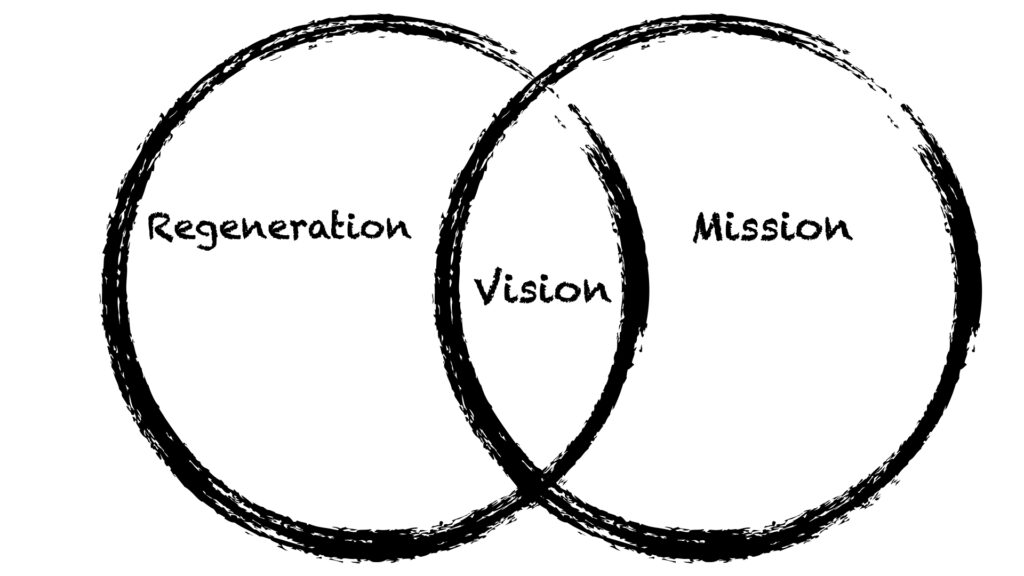
Notice how Vision sits at the intersection – it’s what allows us to honor both our need for regeneration and our calling to serve.
However, this linear scheme tends toward Vision serving here as an intermediary between Regeneration—which are the nourishing forests of our life—and Mission—the cities and associated commitments.
How is this vision cultivated?
This is the super power you find in our window of tolerance, the place where you respond from stillness.
And this stillness is cultivated by formal practices, simple ones like the Chi Kung practice, meditation or informal ones like journaling, contemplation, light walking, napping.
When you lose access to this state you feel responding to the urgencies of life in a way that doesn’t hold a long therm vision but you are just in survival mode.
You end up doing too much, or be overwhelm and paralysed by life diversity.
The Forest is not bad, the City is not bad the question is: how do you invest your energy
Enjoy your practice.